The Hidden Attachment to Being a Victim
There is something I see often, and it is one of the more difficult truths to talk about, especially in spiritual spaces where people are genuinely trying to heal.
Not all suffering continues because you are powerless. Sometimes, it continues because a part of you is still attached to it.
That does not mean your pain is not real. It does not mean what happened to you was okay. It does not dismiss the hurt, betrayal, loss, or confusion you may have experienced. All of that matters. All of that leaves an imprint.
But at some point on the healing path, something deeper is required. Healing is not just about understanding what happened or even clearing the emotions connected to it. It is about releasing the identity that formed around the experience.
And this is where many people unknowingly stay stuck.
Being a Victim
Being a victim is not just something that happens to you. Over time, it can quietly become something you identify with. Not in an obvious or intentional way, but in subtle patterns that begin to shape how you see yourself and your life.
You may notice it in how often the story comes up, how strongly you feel the need to explain what happened, or how difficult it feels to fully move forward without some kind of resolution, acknowledgment, or justice. You may find yourself measuring your healing by whether the pain is completely gone, rather than by how you are choosing to live now.
At a deeper level, the identity of being the one who was wronged can start to feel stabilizing. It explains things. It creates a framework. It even protects you in some ways, because as long as you are the victim, you are not required to step fully into what comes next.
This is the part most people do not realize. The victim's identity can quietly shift responsibility, not for what happened, but for what you choose to do moving forward. And while that may feel relieving at first, it is also what keeps healing from fully landing.
Healing
Healing requires movement. It asks you to come into the present and begin relating to yourself and your life in a new way. But the victim's identity is rooted in the past. It is organized around something that already happened.
So what often occurs is a kind of loop. You gain insight. You become more aware. You may even feel better temporarily. But the core pattern does not fully shift, because part of you is still oriented around the original wound.
You may find yourself revisiting the same issue again and again, each time with more understanding but without a true sense of completion. You may feel resistance to closure, even if you say you want it, because letting go of the pain can feel like losing a part of who you have been. You may even notice similar experiences continuing to show up in your life, not because you want them, but because your identity is still aligned with that frequency.
This is not a failure. It is not something to judge yourself for. It is simply something to become aware of.
Letting Go
Letting go of the victim identity does not mean you are saying what happened was acceptable. It does not mean you are bypassing your feelings or forcing forgiveness before you are ready. It means you are no longer willing to let that experience define your present or dictate your future.
It is a shift into something far more powerful, even if it feels unfamiliar at first. You begin to recognize that while you were not responsible for what happened, you are responsible for what you choose now. You begin to step into authorship of your life rather than staying anchored in a chapter that has already passed.
And this is where things can feel uncomfortable, because without that identity, you are left with a different question. Who are you if you are no longer the one who was hurt, betrayed, or held back? Who are you becoming if that story is no longer the center of your experience?
Many people hold on longer than they realize because there are real needs underneath it. A need to be seen. A need to be validated. A need for the experience to be acknowledged as significant. Sometimes even a need for protection, because moving forward can feel vulnerable.
All of that is understandable. But healing deepens when you begin to meet those needs in new ways rather than tying them to the past.
Making the Shift
Shifting out of victim energy does not look like pretending everything is fine. It looks like telling the truth about what happened without needing to live inside it. It looks like allowing your emotions to move through you without building your identity around them. It looks like making choices based on who you are becoming, not just what you have survived.
A quiet strength begins to emerge when you do this. Not a forceful or performative kind of strength, but a grounded sense of clarity and self-trust. You are no longer waiting for something outside of you to change before you allow yourself to move forward.
If you are unsure whether this is affecting you, there is a simple question you can ask yourself. Who would I be without this story, and am I willing to become that version of myself?
If that question brings up resistance, hesitation, or even a sense of loss, that is not a problem. It is an indication that you are standing right at the edge of a deeper level of healing.
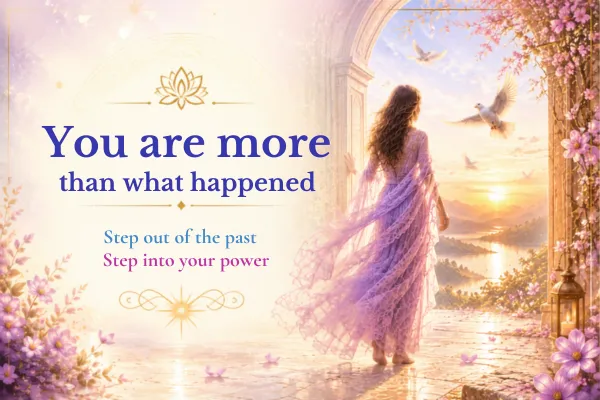
You are not wrong for what you have experienced. You are not weak for how it affected you. But you are also not meant to stay defined by it.
There is a version of you that carries the wisdom of what you have been through without being bound to it. A version of you that is no longer shaped by the past in the same way, even though it remains part of your story.
Healing begins the moment you choose that version of yourself, even before it feels completely natural.
And from there, everything begins to change.